Runtime control for AI agents that can act
HSecure evaluates your agent's tool calls against local policy before they run, requires human approval for risky actions, and keeps an evidence trail of every decision - all on your machine.
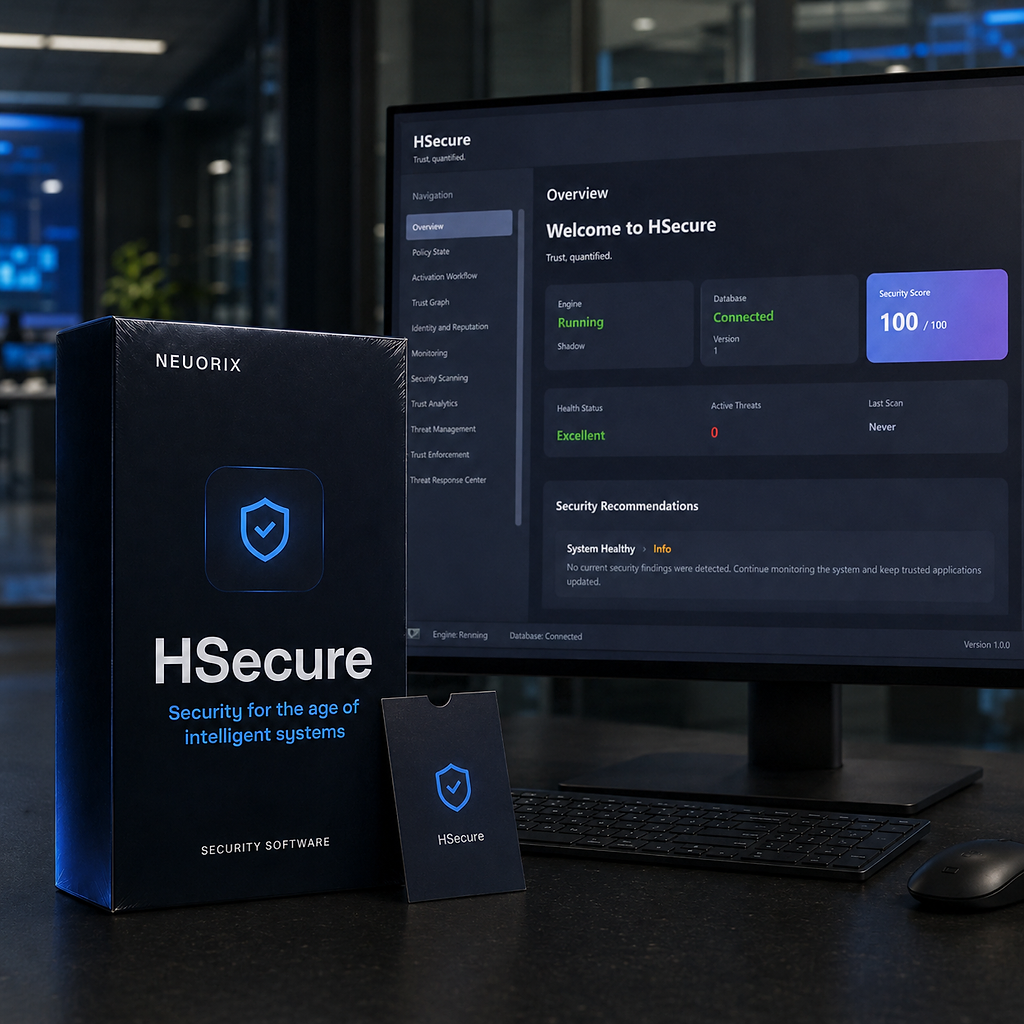
Demo Visualization
01The Problem
AI agents do more than generate text
Tool-using agents can access files, run commands, call APIs, and invoke MCP tools. Each action is a real change in the world - and most security tooling was not built to govern actions at that level.
Access files
Read, write, or modify files on disk.
Run commands
Execute shell or system commands.
Call APIs
Send requests to external services.
Use MCP tools
Invoke Model Context Protocol integrations.
02How It Works
Five stages, every action
Each agent action passes through the same pipeline before it is allowed to execute.
Observe
HSecure sees the tool calls an agent attempts through an enabled integration adapter.
Normalize
Each attempted action is structured into a common format: the action, its arguments, and the target resource.
Evaluate
The action is checked against local policy rules and, optionally, behavioral risk signals.
Decide
HSecure allows the action, blocks it, or routes it to a human for approval.
Explain
Every decision is logged with the policy and signals that produced it, creating an auditable record.
Exact visibility depends on the enabled integration. HSecure only evaluates actions exposed through a connected adapter.
03Core Capabilities
What HSecure does
Action-level policy
Rules defined per action, not per session. Allow, block, or approve based on what the agent is actually doing.
Behavioral drift signals
Optional comparison of ongoing behavior against a baseline to surface unexpected patterns.
Human approval for risky actions
Route high-risk actions to a person before they execute.
Local evidence and audit history
Every decision is recorded locally with the policy and signals that produced it.
Sensitive-data redaction
Configurable redaction of sensitive values before they reach logs or external services.
Offline operation
Local policy evaluation runs without a network connection.
Integration adapters
Connect supported agent frameworks so HSecure can see and govern their tool calls.
Explainable decisions
Each allow, block, or approval comes with the reason it was made.
04Local-First Architecture
Security data stays under your control
HSecure runs on the same machine as your agent. Policy rules, evidence, and approval workflows stay local. Local software is not automatically perfectly private - your operating environment, access controls, and configuration still matter - but your security data is not sent to a separate cloud service by default.
07Demonstration Scenarios
How HSecure would respond
These are demo scenarios illustrating the intended behavior, not case studies from live deployments.
Prompt injection attempt
An agent receives an instruction that tries to override its constraints. HSecure evaluates the resulting tool call against policy before it executes.
Unexpected file access
An agent attempts to read a file outside its expected scope. HSecure checks the action against policy and can block or route it for approval.
Behavior drift after deployment
An agent's behavior shifts from its established baseline over time. HSecure surfaces the deviation as a risk signal for review.
06Who It's For
Built for teams working with agent actions
AI agent developers
Building tools that take real actions and need a guardrail layer.
Small security teams
Need runtime control without standing up a cloud security platform.
Engineering leads
Responsible for what AI agents do in production.
Compliance and audit
Need an evidence trail for agent decisions.
Researchers
Experimenting with agent autonomy and need a safety boundary.
Initial scope
Initial scope: HSecure's initial scope does not include critical infrastructure, medical devices, weapons systems, or emergency-response environments. These require dedicated, domain-specific validation beyond the current technical preview.
05Differentiation
Focused security without another cloud control plane
Local-first - policy and evidence stay on your machine, not in a separate cloud control plane.
Action-level decisions - HSecure governs individual tool calls, not just network traffic.
Deterministic policies - explicit rules you define, with optional behavioral signals on top.
Local approvals - risky actions route to a person on your team, not to a cloud workflow.
Explainable evidence - every decision comes with the policy and signals that produced it.
Accessible to smaller teams - no cloud platform to stand up or manage to get started.
08Future Roadmap
Planned coverage
The categories below represent planned future coverage, not currently available capabilities. Each will require an explicit, tested integration before HSecure can govern actions within it.
Personal Computers
AI Development Platforms
Autonomous Vehicles
Robotics
Enterprise Networks
IoT & Sensor Arrays
AI Agents & LLMs
Industrial Systems
Request a technical preview
Tell us about your agent and what it can access. We will review your setup and follow up directly.
Your information is used only to evaluate your technical preview request and contact you about it. We do not share or sell inquiry data. See our Privacy Policy for details.
Questions, answered
HSecure is a local-first runtime security and authorization layer for tool-using AI agents. It evaluates agent tool calls using local policy and behavioral risk signals, then allows, blocks, or routes actions to a human for approval.
No. HSecure is security software that observes and governs the actions of AI agents. It does not act autonomously.
HSecure evaluates tool calls made by supported AI agents through integration adapters. Exact visibility depends on which integration is enabled and what actions that integration exposes. HSecure does not automatically see everything an agent does.
HSecure is designed around controlled action interfaces. Device support requires an explicit tested integration. HSecure does not currently claim universal visibility or control across physical systems.
HSecure runs locally and evaluates actions on the machine where the agent runs. Policy and evidence stay under your control rather than being sent to a separate cloud control plane.
Technical-preview support is being finalized. Request a technical preview and tell us which framework or agent stack you use; supported integrations will expand based on demand.
Yes. Local policy evaluation does not require a network connection. Integration adapters that depend on external services will naturally need those services to be reachable.
HSecure compares ongoing agent behavior against an established baseline and surfaces deviations as risk signals. Behavioral signals are optional and complement deterministic policy; they are not a replacement for explicit rules.
HSecure is in technical preview. Capabilities described here reflect the current design direction; some items are planned and will be labeled accordingly. Request a technical preview for a grounded conversation about your use case.